
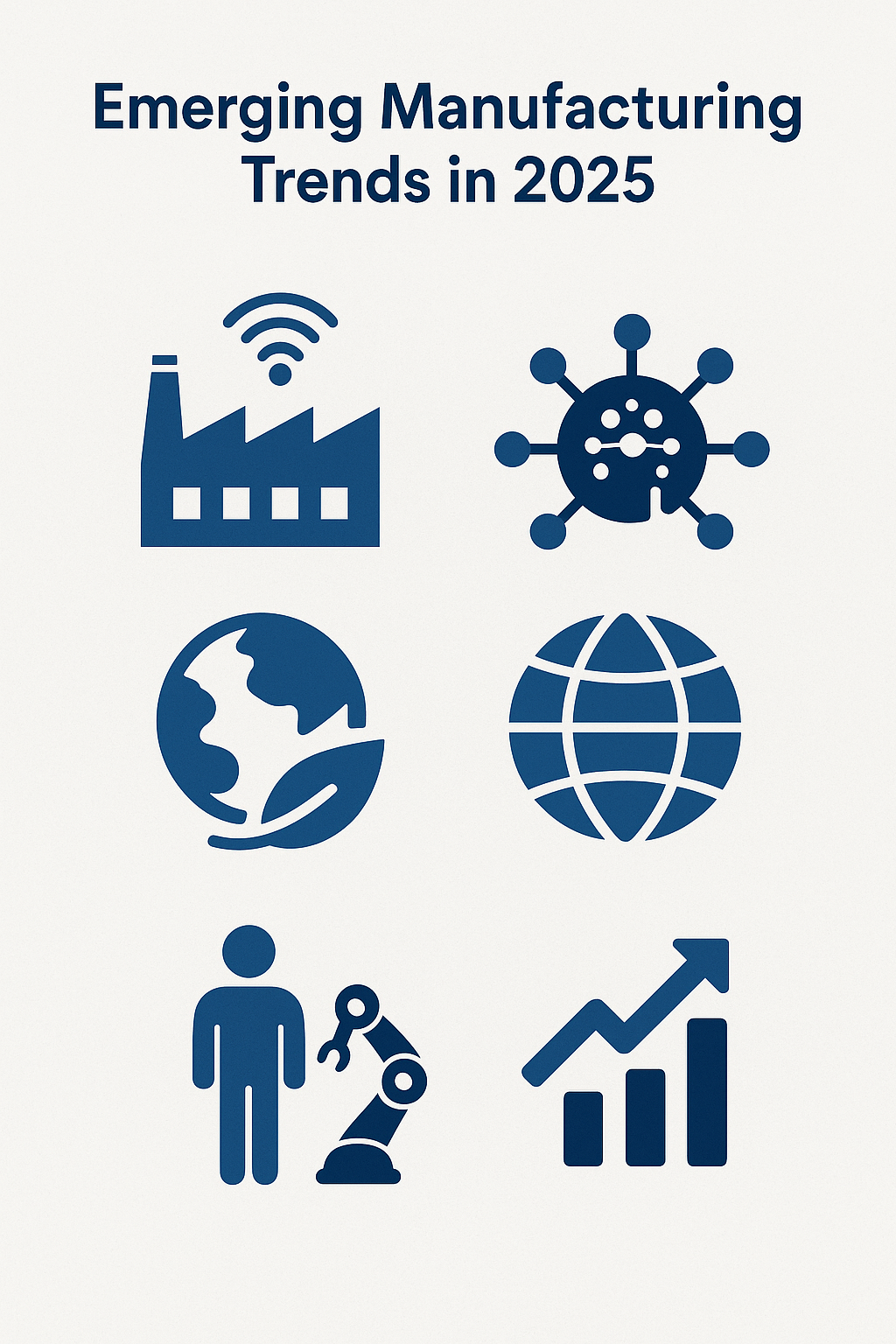
In recent years manufacturing has faced huge shifts—AI, climate pressure, supply chain shocks, labor changes—and in 2025 those pressures are converging. Below are the major trends that are shaping the manufacturing landscape this year, with insight into what companies should be doing to adapt.
1. Smart Factories & Industry 4.0 Maturation
What was once experimental deployment of sensors, connectivity, and automation is now becoming baseline infrastructure. Manufacturers are moving from pilot “smart factory” projects to more fully integrated, data-driven operations. Key elements:
- More real‑time data collection via IIoT (Industrial Internet of Things).
- Increased investment in automation hardware: robots, vision systems, sensors.
- Digital twins and virtual simulation for process optimization, scenario planning, and maintenance.
2. AI & Machine Learning Driving Efficiency
AI/ML is no longer niche; it’s becoming a core component of operations. Key uses include:
- Predictive maintenance: anticipating failures before they occur to reduce downtime and maintenance costs.
- Quality control: using computer vision, defect detection, anomaly detection in real time.
- Process automation: from supply chain forecasting to scheduling to energy optimization.
3. Sustainability, ESG & Carbon Neutrality
Environmental concerns and regulation are pushing manufacturers to rethink how they operate. Trends include:
- Pressure to reduce carbon emissions across operations, including renewable energy integration and energy efficiency in factories.
- Circular economy practices: reuse/recycle materials, design for disassembly, waste reduction.
- More transparency and reporting driven by ESG requirements from customers, governments, and investors.
4. Resilient & Digitized Supply Chains
Supply chain disruptions from recent years have left their mark; companies are responding:
- Digitization of supply chains: tracking goods in real time, better forecasting, visibility into suppliers and logistics.
- Near‑shoring and reshoring: bringing production or component sourcing closer to home to reduce risk.
- Flexibility and redundancy: multiple suppliers, modular production capabilities, contingency planning.
5. Workforce, Skills & Human‑Centered Design
Technology is advancing fast, but people remain central. Key trends:
- Growing skills gap: need for employees with data analytics, AI/ML, robotics experience.
- AR/VR for training, maintenance, and remote support.
- Human‑machine collaboration: “cobots” (collaborative robots) that work alongside humans.
6. Security, Interoperability & Data Governance
As connectivity and digitization expand, risks and complexity grow:
- Cybersecurity in manufacturing is increasingly critical—protection of data, systems, operations.
- Interoperability between legacy systems and new technologies.
- Regulations around data privacy, cross‑border data flows, and compliance are becoming more important.
7. Growth Mode & Strategic Expansion
After years of reacting to disruptions, many manufacturers are moving into a proactive “growth mode”:
- Identifying new markets, product lines, and services built on data.
- Strategic investment in capital assets, R&D, and digital infrastructure.
- Taking advantage of government incentives for clean tech, reshoring, and innovation.
What Manufacturers Should Do to Stay Ahead
To thrive amid these trends, here are some recommended actions:
- Audit your current state—where are you on automation, AI adoption, data infrastructure, sustainability?
- Prioritize digital infrastructure—invest in sensors, connectivity, and cloud/edge computing.
- Build skills/upskilling programs—train employees in digital tools and data analytics.
- Start small but plan for scale—pilot projects like digital twins or AR training can scale over time.
- Embed sustainability as a core, not add-on—environmental goals often align with cost savings.
- Strengthen supply chain resilience—map your suppliers, build in redundancy, explore nearshoring.
- Invest in security and governance—protect data, ensure compliance, and manage digital risks.
Conclusion
2025 is shaping up to be a decisive year for manufacturers who want to move from reactive to proactive. Those who integrate smart technologies, commit to sustainability, invest in their people, and build resilient operations will win competitive advantage. For a spring manufacturer (or any specialized manufacturer), applying these trends thoughtfully—whether via smart factories, predictive maintenance, or energy efficiency—can translate into better quality, lower costs, and long-term viability.