
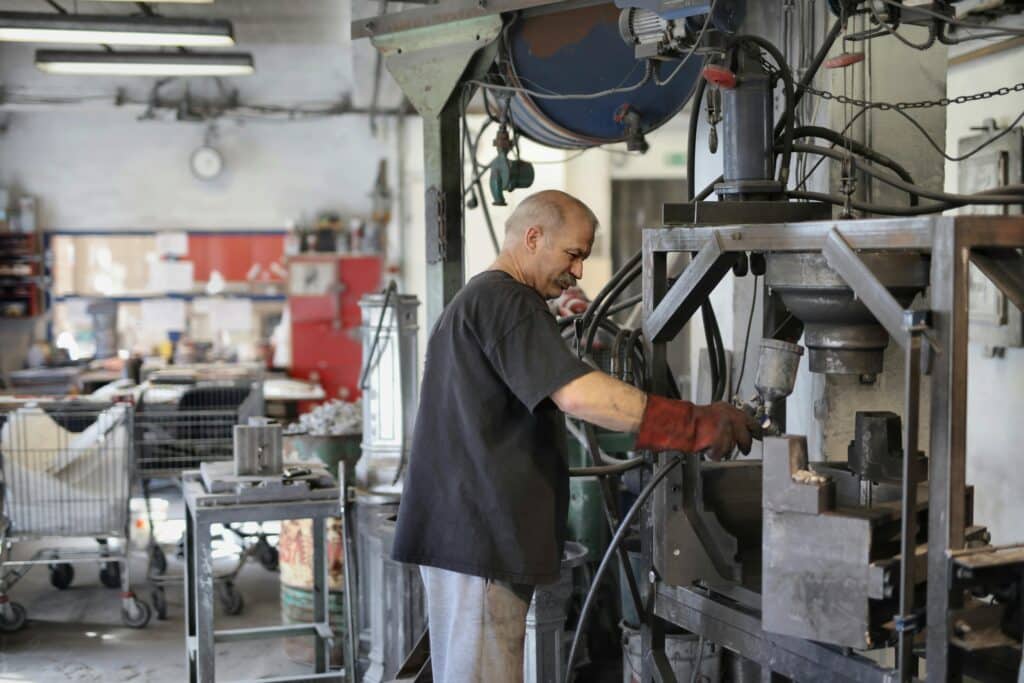
Skilled labor in spring manufacturing remains one of the most pressing issues facing the industry in 2026. While manufacturers continue to manage material costs, lead times, and shifting customer expectations, the workforce challenge remains especially difficult because it affects nearly every part of the operation. From machine setup and tooling to quality control and troubleshooting, spring manufacturing depends on trained employees who understand precision, process control, and consistency.
This challenge is part of a much larger story across U.S. manufacturing. Employers throughout the sector are still struggling to fill critical roles, and that pressure continues to impact output, training, and long-term growth. For spring manufacturers, however, the problem is often even more specific. Skilled labor in spring manufacturing is not just about finding people to work on the floor. It is about finding people who can learn specialized processes, hold tight tolerances, recognize defects, and contribute to repeatable quality over time.
That distinction matters. To someone outside the industry, a spring may seem like a straightforward component. Inside the plant, the reality is very different. Precision spring manufacturing involves complex forming, material behavior, machine setup, inspection requirements, and application-specific performance expectations. Whether a company is producing compression springs, extension springs, torsion springs, or custom wire forms, the end result depends on employees who can combine technical knowledge with practical experience.
This is exactly why skilled labor in spring manufacturing continues to be such a serious concern. The work requires more than general manufacturing ability. It requires judgment, attention to detail, and a deep understanding of how small process changes can affect spring performance. An operator or setup technician is not simply running equipment. That person may be helping maintain dimensional accuracy, force consistency, surface quality, and production efficiency all at once.
As older workers retire and fewer young people enter the trades, many manufacturers are feeling the loss of experience in real time. When veteran team members leave, they often take years of knowledge with them. In spring manufacturing, that knowledge may include tooling adjustments, machine behavior, material response, inspection habits, or process shortcuts that were learned only through years of hands-on experience. Replacing that kind of expertise is not easy, and it rarely happens quickly.
That is why workforce development has become such an important business priority. Skilled labor in spring manufacturing is no longer just a hiring issue. It is a quality issue, a production issue, and a growth issue. If manufacturers cannot recruit, train, and retain capable employees, they may struggle to expand capacity, respond to customer demand, or maintain the service levels that buyers expect.
Training is a major part of the solution. Many spring manufacturers can no longer rely on the labor market to deliver fully prepared candidates with direct industry experience. Instead, they need to create stronger internal training systems that help employees build skills over time. That includes onboarding programs, machine-specific instruction, mentoring, cross-training, and more intentional knowledge transfer from experienced workers to newer team members.
For many companies, the most effective approach is to treat training as an ongoing investment rather than a one-time task. Skilled labor in spring manufacturing develops gradually. Employees need time to understand not just how a machine works, but why precision matters, how tolerances affect performance, and how process variation can lead to downstream problems. When manufacturers build that understanding internally, they create a more resilient workforce and reduce their dependence on an already tight labor pool.
Retention is equally important. Recruiting new employees matters, but keeping trained employees matters even more. In a specialized field like spring manufacturing, turnover can be expensive. Every time an experienced worker leaves, the company loses productivity, knowledge, and often training time that cannot easily be recovered. That is why more manufacturers are focusing on career development, plant culture, compensation, and long-term advancement as part of their workforce strategy.
A strong retention strategy can also improve overall operational performance. When employees stay longer, they become more comfortable with equipment, quality standards, and customer requirements. That consistency can support better throughput, fewer errors, and stronger communication across departments. In that sense, addressing skilled labor in spring manufacturing is not just about filling jobs. It is about building a stronger and more dependable operation.
Partnerships can also help. Technical schools, community colleges, and local workforce programs can play an important role in introducing new talent to manufacturing careers. For spring manufacturers, these relationships can create a more reliable pipeline of workers who already have exposure to machining, inspection, blueprint reading, mechanical systems, or industrial processes. While that training may not be spring-specific at first, it provides a useful starting point for building the next generation of skilled employees.
Manufacturers also need to do a better job telling the story of what modern manufacturing work actually looks like. Too often, younger workers and job seekers still picture manufacturing through an outdated lens. In reality, spring production is technical, precise, and essential to countless industries, from automotive and aerospace to medical devices, electronics, and industrial equipment. When companies communicate that clearly, they have a better chance of attracting individuals who want stable, hands-on, high-skill careers.
Technology is adding another layer to the conversation. Today’s manufacturing environment increasingly includes automation, digital systems, and more advanced process monitoring. That does not eliminate the need for people. In many cases, it raises the value of skilled workers even further. Skilled labor in spring manufacturing now includes people who can adapt to evolving equipment, interpret data, support quality systems, and troubleshoot with a mix of technical knowledge and shop-floor experience.
This shift makes workforce development even more urgent. The industry does not just need more workers. It needs workers who are trainable, adaptable, and capable of growing with more advanced manufacturing environments. That is especially true in precision spring manufacturing, where small deviations can have major consequences for product performance.
For spring manufacturers, the path forward is clear. Companies need to invest in people with the same seriousness they invest in machinery, tooling, and materials. That means building training programs, strengthening retention efforts, supporting knowledge transfer, and creating clearer pathways into the industry for new talent. Skilled labor in spring manufacturing is still one of the biggest challenges in 2026, but it is also one of the most important areas where companies can make strategic improvements.
The manufacturers that respond well to this challenge will be better positioned to protect quality, improve lead times, and support long-term growth. In an industry built on precision and reliability, the workforce behind the process remains one of the most valuable assets a company has.